Friday, December 16, 2011
There's No Place Like Home for the Holidays
There truly is no place like home for the holidays, just take it from T-Mobile who filmed a surprise video at Woodfield mall this holiday season. Woodfield mall, the same Woodfield mall that's only 15 minutes from my home! I can't wait to be home! My mom's on her way driving down to Champaign now to come get me and my life's belongings to first move into my sorority house (where I'm living next semester!) and then to go home to my real home.
So in essence I'm very blessed to be able to say I'm truly going home for the holidays. I'm leaving dorm-living for my sorority house, which will be my new home for Spring semester; however what I'm looking forward to the most is being with my family and friends back home for Christmas.
Today is the first day I've actually had that holiday cheer. :) Finals are over and it's time to make my way home to the ones I love!
Merry Christmas and Happy Holidays everyone!

Friday, November 18, 2011
Hello...Is anyone out there?
I think this is the first time that Van Doren has been quiet on a Friday night. Everyone has packed up their bags and gotten on a bus that will take them back to the place they call home. I'm sitting in my room staring at the pile of laundry that needs to be folded and thinking about what I need to pack to go home. It's Thanksgiving break! I couldn't be happier to go home. I love this campus so much, but after a week as crazy as the one I had this week, it's time for a break. I'm excited to see my family and friends from home, but I can't help but think about how much I'm going to miss everyone I've met here so far. I'm even going to miss the cold walk to the Quad in the morning...just because I love the Quad though. I'm going to especially miss my boyfriend, Ross. It'll be weird not seeing him every day like I've been lucky to do here on campus.
Going into this year, I had no expectation of making instant connections with people, but it just so happens that I did. I'll miss waking up to texts from friends asking to go to basketball games or to get lunch at the Ike. How can a whole semester have gone by already? This definitely isn't like high school. I'd have to guess that it's because I actually had a choice in where I went to school this time. When you are given the power to choose something for yourself, you like your choice a lot more than if someone made the decision for you. And this place is no exception. University of Illinois, I love you. Every bit of you. Except CMN 101. But that's besides the point. I'll be back and ready for more in a week, but for now it's time to go home and get a good night's sleep, take a shower without flip-flops on, and to get a good, home-cooked meal. Peace out Chambana.
Going into this year, I had no expectation of making instant connections with people, but it just so happens that I did. I'll miss waking up to texts from friends asking to go to basketball games or to get lunch at the Ike. How can a whole semester have gone by already? This definitely isn't like high school. I'd have to guess that it's because I actually had a choice in where I went to school this time. When you are given the power to choose something for yourself, you like your choice a lot more than if someone made the decision for you. And this place is no exception. University of Illinois, I love you. Every bit of you. Except CMN 101. But that's besides the point. I'll be back and ready for more in a week, but for now it's time to go home and get a good night's sleep, take a shower without flip-flops on, and to get a good, home-cooked meal. Peace out Chambana.
Monday, November 14, 2011
Rejuvenated.
It's official. I'm back to writing my blog. This time it isn't for school though; it's for myself. Writing has always been a hobby of mine and recently I've been feeling like something has been missing in my life. It became clear one evening in a Panera Bread that the only way to fill this missing gap was to start writing again...so here I am at 1 a.m. writing my blog instead of writing my Spanish essay like I should be doing...what can I say? I've been inspired.
(Work needs to be done on the formatting but I'm more concerned with writing at this time of day.)
_________________________________________________________________________
I've been having one of those stressful days, you know, the ones where you're so stressed out that you can't get yourself to do your homework and just stress yourself out more because you're falling even farther behind. It all started when the monsoon hit Champaign earlier this afternoon, wiping away the 75 degree temperatures that were short-lived. I was so stressed out today that I felt sick after eating a light dinner of broccoli and mac and cheese. I sat down at my desk after coming back from dinner just to struggle through writing a paragraph of a Spanish essay and was about ready to call it a night when I realized there was still a chance the day could be saved.
Running. It's my passion, it's my life, and it's my go-to activity to relieve stress. So at 10:30 I decided to trek over to the ARC (our school's workout facility) to run. When I entered the ARC, I was so surprised at how many people were working out so late and how happy the atmosphere was. What did they know that I didn't? I would soon find out that I was in for more than a work-out, but also a valuable lesson. I found a treadmill on the first floor of the ARC and just started to run. 5 miles later I was done, and feeling much better about myself. I had burned almost 500 calories on my run, what wasn't there to be happy about?
However, looking around at the people around me, I realized that many of the people who go to the ARC at 10:30 at night aren't going to burn calories, they're going to burn stress. They go to melt the stress away. As gross as it is I thought about sweat and how it was like the stress being melted out of my system. People go to work-out late at night because it's therapeutic, and as college students, they need a chance to get away from all of the homework and other time consuming activities.
Maybe this is why the ARC is such a happy place. It's a place to leave all of your stress and forget about everything that's going on in your life temporarily. Oh and the endorphins aren't that bad either :P
(Work needs to be done on the formatting but I'm more concerned with writing at this time of day.)
_________________________________________________________________________
I've been having one of those stressful days, you know, the ones where you're so stressed out that you can't get yourself to do your homework and just stress yourself out more because you're falling even farther behind. It all started when the monsoon hit Champaign earlier this afternoon, wiping away the 75 degree temperatures that were short-lived. I was so stressed out today that I felt sick after eating a light dinner of broccoli and mac and cheese. I sat down at my desk after coming back from dinner just to struggle through writing a paragraph of a Spanish essay and was about ready to call it a night when I realized there was still a chance the day could be saved.
Running. It's my passion, it's my life, and it's my go-to activity to relieve stress. So at 10:30 I decided to trek over to the ARC (our school's workout facility) to run. When I entered the ARC, I was so surprised at how many people were working out so late and how happy the atmosphere was. What did they know that I didn't? I would soon find out that I was in for more than a work-out, but also a valuable lesson. I found a treadmill on the first floor of the ARC and just started to run. 5 miles later I was done, and feeling much better about myself. I had burned almost 500 calories on my run, what wasn't there to be happy about?
However, looking around at the people around me, I realized that many of the people who go to the ARC at 10:30 at night aren't going to burn calories, they're going to burn stress. They go to melt the stress away. As gross as it is I thought about sweat and how it was like the stress being melted out of my system. People go to work-out late at night because it's therapeutic, and as college students, they need a chance to get away from all of the homework and other time consuming activities.
Maybe this is why the ARC is such a happy place. It's a place to leave all of your stress and forget about everything that's going on in your life temporarily. Oh and the endorphins aren't that bad either :P
Friday, May 20, 2011
Final Blog Entry!

This week in Sociology class we have been focusing on race and its origins. I was amazed to hear that race does not actually exist and is rather just a concept that we have developed over time to explain the differences in our pigmentation. In reality, we have different skin colors because of the amount of melanin in our skin. The amount of melanin a person has in their skin has evolved over time due to how much sunlight his or her ancestors have experienced. For example, someone growing up in Africa would need more melanin to protect their body from absorbing solar radiation (http://en.wikipedia.org/wiki/Human_skin_color). However someone who grew up in a northern European country would have less melanin in their skin since they are not being hit by as strong of sun-rays.
This isn't to say, however, that our skin color is determined at birth based on the climate that we live in and that we can adapt different skin colors over time depending on we live. It takes THOUSANDS, if not MILLIONS of years for evolution to occur.
Sociological Definition of Race

Biological Definition of Race

IAT Tests
IAT tests, as defined by Wikipedia are:
The Implicit Association Test (IAT) is an experimental measure within social psychology designed to detect the strength of a person's automatic association between mental representations of objects (concepts) in memory. A computer-based measure, the IAT requires that users rapidly categorize two target concepts with an attribute (e.g. the concepts "male" and "female" with the attribute "logical"), such that easier pairings (faster responses) are interpreted as more strongly associated in memory than more difficult pairings (slower responses).
During class we took an IAT test. Here is the link for the tests: https://implicit.harvard.edu/implicit/. I believe that the purpose of taking these tests is to see how society has influenced our ideas about race. From my results, it stated that I had a strong preference for European Americans. I was not surpirsed by my results because we tend to have a preference for people who are most similar to us, but I found it sad that it was a lot easier for me to respond to questions when "good" and "white" was grouped together. I think that this test is measuring what it is trying to measure because you do it without having to think about it very hard and rather just click on what first comes to your mind when you think of "good", "bad", "white", and "black".
African Americans Biologically Superior Athletes?

-------------------------------------------------------------------------------------------------------------
Sociology Review

It's crazy to think that it has already been a semester since I started Sociology class. I feel so much more aware of what is going on around me because of Sociology and I see things in a new light because of it. For example, I have begun to understand how people's environments affect their outlooks on life and how it can affect the rest of their lives. One thing in particular that I'm so glad that I learned was that the "American Dream" is not always achievable. We think that if we work hard enough that we can achieve everything that we set our minds to. However, there are so many other variables that go into it like your parents' experiences and the environment in which you now reside.
I found all of the topics that we talked about in Sociology to be fascinating, but I wish that we would have been able to do a research project to see hands-on how Sociology is part of our everyday lives. I think that it would have been neat to survey people at my own high school and to conduct a study whose results would further educate me in the study of Sociology! I might just have to conduct my own experiment this summer! How's that for Sociologically Imaginative? :)
Friday, May 6, 2011
You Are What You Eat Part 2


The Jewel-Osco pictured above is a good representation of being a marker of social class. Its grand appearance and big glass windows show that it must be located in an affluent area. "...America is a place of extremes, and what you eat for dinner has become the definitive marker of social status..." (Divided We Eat).
 However, not only food is a marker of our social status. From the "Social Class in America" video that we have been watching in class, we saw that objects can be symbols of status. In other words, a "status symbol". Think about the clothes that you own, the car that you drive, or the electronics that you have. You bought all of these things either consciously or unconsciously to enhance your status. I remember in 7th grade, all of the girls were starting to buy Juicy Couture sweatpants and hoodies. I remember going to Macy's and looking at the price label for a sweatshirt and being appalled at how expensive they were. $92 for a sweatshirt?? Yet it was a purchase I would make in 7th grade because I wanted to elevate my status. Luckily I still own the sweatshirt today so I have at least gotten my money's worth out of it!
On another note, the way that we act also can determine our social class. In the video below we see the reason why Rednecks get the stereotype that they have today...
In the "Social Class in America" video, we saw that some people just want to elevate their social class. For example, Ginnie Sayles (who married a millionaire), offers lessons to make-over one's social class. She charges a whopping price of $1500 for these lessons! You would think that she would not make an income because she wouldn't get any customers, but you'd be surprised at how much people are willing to pay in order to change social classes. But it isn't as easy as taking a few lessons...people know what your status is. The movie "Mean Girls" comes to mind when I think about social status and classes. This movie trailer shows how much attention people give to the stereotypes and where people came from...
For all of you who haven't seen the movie (which is a must-see), it is about Cady, a new-girl from Africa who has just moved to the suburbs, and her struggles to fit in and take-down the reigning social queen, Regina George. It takes Cady awhile to be accepted by Regina because she comes from a different social class than Regina and her friends (Regina drives a silver lexus, has a mansion, and her friend Gretchen's dad invented Toaster Struddle), and even when she begins to dress and act like the girls, they always know how to put her back in her place if she annoys them or does something wrong because THEY KNOW HER ROOTS, where she came from. It is something that people will never forget.


Finally, back to food. The Honors Article said that "...the contents of a child's lunchbox can be fodder for a 20-minute conversation." Shows you how much people care about what other people are eating! From the video, we saw the problems with choosing a community grocery store in Burlington, Vermont. At the heart of this conflict? BREAD. The co-op, which offers healthier choices at a heftier price, did not offer white bread, but rather had fresh bread that was more expensive than what people were willing to pay. This shows that something as simple as bread could symbolize the difference in our classes. The co-op eventually agreed to stock white bread at a cheaper price so that all of the community could be happy with their selection.
As a last note, in the article, it was mentioned that "...Fischler has found no single time of day (or night) when American predictably sit together and eat. By contrast, 54 percent of the French dine at 12:30 each day. Only 9.5 percent of the French are obese." Typically my family has a sit-down meal with the whole family a few times a week, and when we are all not able to eat at the same time, my mom has prepared the meal in advance so that we can eat a healthy meal at whatever time we are able to. Now I know not everyone is lucky enough to do that, but it's interesting how just having a sit-down meal can drastically reduce the obesity rate in a population. Getting McDonald's out of the hands of small children now can seriously help them in the future.
Friday, April 22, 2011
Social Stratification
Social Stratification: a system in which people are divided into layers according to their relative power, property, and prestige.

Whether or not we choose to believe it, we are born into a social status. Children of the wealthy are automatically considered a level above the rest, while children of the poor are looked down upon and often deemed uneducated. Luckily in the United States, we are not confined to our social classes forever; however, it is very hard to move up in social class if you have been born into a lower class because you have been influenced by those around you. Just today I was reading a magazine where I saw Willow Smith (daughter of Will and Jada Pinkett Smith) in a photograph with a caption that read "watch for Willow's new debut album coming out this summer." However talented she may be, she had many more opportunities to become a singer because of her parents' connections. It would be much harder from an everyday person to become a famous singer because they do not have the same opportunities as those who have close connections to a recording company.

Willow, only 11 years old at the time of the recording of this song, has over 50 million views on YouTube. I do not think that if she had tried to get a recording contract on her own that she would have been successful at such a young age. Because of her name she was able to gain popularity...she already had social status.
Not everyone is so lucky though. While watching the 20/20 video in class about the people of Appalachia, it was evident that because of the environment that the people were born into, the opportunities they had to succeed were far lower than in other parts of the world. The documentary focused on the children of unsuccessful people in Appalachia and the effects of their environment on their lives. Take Sean Grim, for example. He was a high school football star born into poverty and a deranged family situation. His step-dad is an alcoholic, and his brother-in-law molested his sister. Sean took matters into his own hands and left the family home and lived in a truck to start a new life for himself. He got a football scholarship to a small, private school, and seemed to be heading in the right direction. However, he realized that he still could not afford to be at the university and dropped out after feeling uncomfortable with never being able to go out with friends. He went back home to Appalachia where he resumed life as he knew it before he was motivated to go out on his own and make a new life for himself. This proves the point that it is very difficult to get into a higher social class than what you are born into. Bill O'Reilly on his show, "O'Reily Factor", argued that people should just move out of the area if they knew the implications it had on their children. While he has a good point, it is very hard to get the funds needed to move out when you have grown up in an impoverished area. He argued with Dianne Sawyer about her 20/20 documentary, but Sawyer never seemed to give up. She defended the children saying that this new generation wants change, but they just need the help from the rest of the world to get the same opportunities for education and success to dig themselves and their families out of the rut they are currently in.
Karl Marx, who was the subject of the Honors Article we read for this week, concluded that "an individual's social class was determined by whether or not he owned the means of production." Marx referred to this group of people as the "Proletariats". Marxism, according to the article, is "a theory of how well-heeld capitalist nations might use their immense resources to achieve justice and prosperity for their people." This is very similar to communism, which aims to diminish social class and have common ownership of the means of production. If Marx's beliefs were applied to the United States, more resources and money would be flowing into Appalachia to give them the same opportunities and resources that other parts of the world already have. The article that we read defended Marx's position on the distribution of resources, but also acknoledged that there were flaws with his work. However, it identified that the Capitalist society in which we live today, as predicted by Marx, has intensified the inequalities in society.
Thursday, April 14, 2011
"Make Me A Sandwich"

"A woman is often measured by the things she cannot control..." Immediately every woman who ever reads this ad is intrigued because they can relate to the statement. The honors article that we read spoke of the Nike ad featuring a "natural" Marilyn Monroe. Pictured above is the advertisement that was produced in 1992. The ad encourages people to measure people from the inside and not from the outside. Too often do we judge people based on their looks instead of on their character; we can't always get past the outward appearance and never truly get to know the person. If people started to accept the fact that women's bodies are all different from one another, then the concept of beauty would change. The article says that "one way of being beautiful will be, for all times and all places, more healthy, more natural and less harmful than all others."
So what exactly is beauty? Is it your physical appearance or your inside appearance, or a combination of both? I think that beauty can be defined in many different ways. The Dove Onslaught video below gives us a good idea of what society has defined beauty to be...
It's incredible how much society can influece children from a young age in their view of beauty. Young girls like the girl in the Dove commercial should not have to worry about measuring up to society's standards. That adds so much unneeded pressure to a young girl's life and can lead to her destruction. So this topic of beauty...what do you think it means? I think beauty is being confident in yourself and with who you are and how you appear. I think beauty is natural, and not cosmetic. The article says that "women should feel their natural selves are beautiful enough." The only reason that plastic surgery became so popular was because people thought that they had to look a certain way to be accepted in society. It's interesting to me to think about beauty from different perspectives. What makes certain people think that some things like being super skinny is attractive, while other people think that having a full-figured body is more attractive.
Recently there has been a growing amount of Feminists in this country. This is because of the image of male dominance in society and the perception that men are better than women. These ideals are again taught to young children through the media, and surprisingly enough through the Disney movies that we watched as kids. I found the following clip to be a good representation of the male dominance shown through the movies...
One scene from the video that I clearly remember is the song from Mulan where one of the men says that choosing a women depends on her cooking skills. This perception that women are house keepers goes back to the gender role created centuries ago. The joke today that many men find hilarious is "make me a sandwich", as if that's what they view women good for. Even my 13 year old brother thinks that because I'm a girl that I enjoy making food for other people! He asks me all the time to make him a snack, and I return his request by giving him a recipe to follow. I don't want to prolong the stereotype!
I refuse to accept the fact that gender roles cannot be reversed. For example, many dads are becoming stay at home dads while their wives are working to support the family. I find it extraordinary how some men feel so superior to women when they might not be as intelligent or as hard-working as some women are. This bothers me a lot in high school because some of the boys in my senior class think that they are so much better than me just because they are male when in reality I have a higher GPA, ACT, and social status than they might. I know it sounds a little stuck up, but I think that girls eventually start to justify things like this to make themselves feel better about being discriminated against. I know I find comfort in rationalizing the situation! I believe that women are just as capable as men in being successful in the world. It's no wonder why more women go to college nowadays than do men! Hopefully some day the roles will even out and men and women will be able to embrace each others' differences and use them to their advantage to accomplish things succinctly! But until that day comes I still won't be making any sandwiches for men...unless of course it would get me a date to prom (totally kidding!, I think if someone asked me to do this I would tell them to have a nice life!)
I refuse to accept the fact that gender roles cannot be reversed. For example, many dads are becoming stay at home dads while their wives are working to support the family. I find it extraordinary how some men feel so superior to women when they might not be as intelligent or as hard-working as some women are. This bothers me a lot in high school because some of the boys in my senior class think that they are so much better than me just because they are male when in reality I have a higher GPA, ACT, and social status than they might. I know it sounds a little stuck up, but I think that girls eventually start to justify things like this to make themselves feel better about being discriminated against. I know I find comfort in rationalizing the situation! I believe that women are just as capable as men in being successful in the world. It's no wonder why more women go to college nowadays than do men! Hopefully some day the roles will even out and men and women will be able to embrace each others' differences and use them to their advantage to accomplish things succinctly! But until that day comes I still won't be making any sandwiches for men...unless of course it would get me a date to prom (totally kidding!, I think if someone asked me to do this I would tell them to have a nice life!)
Thursday, April 7, 2011
Socialization In All Shapes, Forms, and Sizes.

-Mom
-Relationships
-Submissive
-Pretty
-Slim/Small
-Sensitive/Emotioal
*Any woman acting outside of these characteristics will be labeled a whore, a bitch, or a slut.

-Powerful
-Sports
-Tough
-Strong
-Protective
-Aggressive
-Big
-Dominant
*Any man acting outside of these characteristics will be labeled gay, homo, or wimpy.
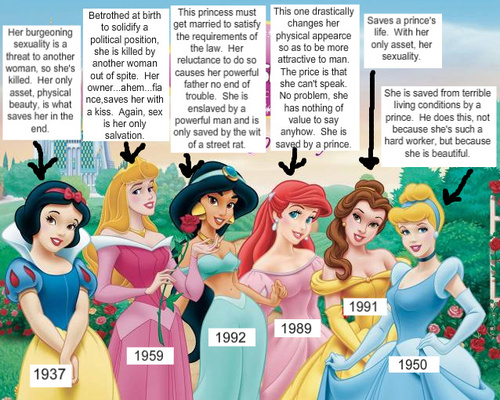
During Sociology class on Thursday, we wrote down society's perceived characteristics of both women and men. It was interesting to see how society has formed both genders as a result of telling them how they should act and what they should and should not like. This starts from a young age, as we saw from the in-class activity that we did throughout Tuesday and Wednesday in the computer lab in which we completed activities that showed us society's skewed perception of the world and the people that make it up. It was scary to think that the messages of being pretty and submissive to men are taught to girls at such a young age through Disney movies! The media should be trying to make a positive impact on young girls to establish their self confidence from early on and not to tear them down and make them think that they are inferior to men and that this is the way society should be.
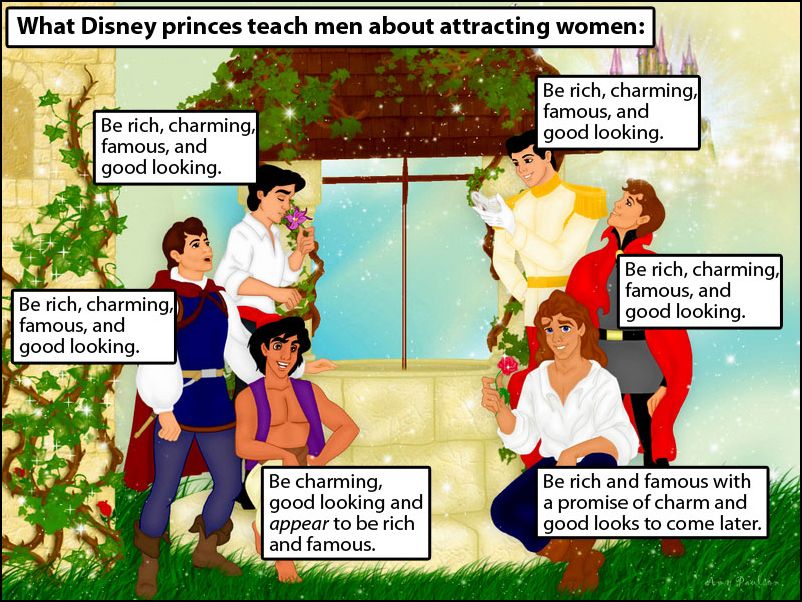
However, men don't get off the hook that easily either. The princes in the Disney movies also teach them the views of society and their role in that society. Most all of the princes teach boys that it is important to be rich and good looking in order to succeed in society. It disgusted me to think that this is what children have been seeing for many years and that they have probably internalized what they have watched.
Boys and girls are taught different things from a young age because of their sex, or physiological make-up. However, their gender takes on a whole different meaning. Gender, as we explained in sociology class, is how we identify ourselves as learned from the society around us. Most girls learn to act like society's perception of how a girl should act because they are expected to do so and are raised in this fashion. Thus is so with the Fafafini, the third gender in Samoa. Fafafini are men raised as girls by their family, but are acknowledged as their own gender. In our society in the United States, most people would consider the relationship that the Fafafini have with other men to be homosexual. However, the Fafafini are not considered gay because they have taken on the gender as a woman, and therefore like men. I thought that it was interesting, and almost sad, that if there aren't enough women to do chores that a family will raise a boy as a Fafafini. It seems like the boys are not given a choice and do not fully understand who they are until they are older.
Fafafini
We act the way that we do because of the influences of those around us on ourselves. From the honors article that we read, "Durkheim observed that human beings experience society's influence as a force outside of themselves that constrains their behavior." Muzafer Sherif took things a step further and identified that there is a "personal norm" present in every human being. This means that "the individual comes to perceive the situation in line with the views of others, and is frequently unaware that he has been influenced." I thought that this was interesting because if you think about it, there is no true-self since we are a compilation of all our past experiences and choices. I thought that the video below was interesting because it presents some characteristics of the "typical" person on the earth, as aided by society.
To again reference Cooley's "Looking Glass Self", people "imagine themselves as others must see them." I know that girls in particular are so engrossed in their image and how other people perceive them that they will go to the extreme to make their bodies perfect. During the internet activity that we did in class, we got to see before and after shots of women who had been photo-shopped for billboards or magazines. One video that really made my jaw drop was the Dove Evolution commercial. I think that it is so great that Dove is trying to make people aware that our view of beauty is distorted and that what we see on the billboards isn't always what is really there. I have posted the video below for blog readers to watch. I know that from personal experience, I have always tried to achieve the body type of the girls that I see on the cover of my magazines because that is what society has taught me is attractive. I've started to notice how my environment truly does affect how I look because over time I have been evolving in terms of what I care about with my body. For example, over time girls begin to wear more and more makeup because they constantly see that "this mascara will make your lashes look longer" or "this concealer will take away any blemishes that you have." I've realized that even in the past year I have started to wear more makeup because it makes me look older and cleaner. However, I am still comfortable going out in public in sweatpants and a sweatshirt without any makeup on during the weekends fortunately!
Thursday, March 31, 2011
Refresh, Refresh, Refresh-The "Looking-Glass Self"

Facebook has become the predominant social networking site for teenagers and young adults. How many times have you sat in front of your computer clicking "refresh" waiting for a comment or someone to like your status? We live in a society where instant gratification is everything. It's amazing how a text from the guy we like or a complimenting comment on one of our pictures can make our day in one split second. I can't even imagine being in my parents' shoes and having to pick up the phone and actually call someone if I wanted to have a conversation! And no, it wouldn't be through a cell phone; at that time it would have been through a phone with a cord most likely located in a family area such as the kitchen where everyone could hear your conversation! Secretive is one of the best adjectives to describe adolescents. With the use of technology, being secretive is easier than ever....
In class we watched a Frontline video on teenagers and the internet. One girl featured on the episode was "Autumn Edows". Jessica, known as "Autumn", created a new risque persona for herself to express her true self through the internet where she would not be judged, unlike how she was at school. She constantly uploaded photos of herself to her website without the knowledge of her parents until her website was discovered by another parent of a student in her school and was brought to the attention of the school principal. Her parents were shocked when they found out what she had been posting and initially thought that it was wrong. However, eventually they came to the conclusion that they did not want to stifle Jessica's creativity and let her express herself through her site. She wasn't a bad kid, she just found a way to be accepted and creative through the internet.
 Like Jessica, many teenagers see themselves through the reactions of others. This is known as the "Looking-Glass Self" as formulated by Charles Horton Cooley. "Cooley used the familiar figure of a person looking at his or her refelction in a mirror as a metaphor for understanding the development of the social self." ("From Mirror Self-Recognition to the Looking-Glass Self: Exploring the Justification Hypothesis", Leigh S. Shaffer). A well discussed topic in class, the question was brought up if a "true-self" actually existed if we are only seeing ourselves to others and conforming to what we think they see in us. Personally, I believe that a "self" is a compilation of past experiences and choices that we have made on our own that defines who we are. Although people may have similar characteristics, we are all our own "self" if we so choose to be. I think that when one makes a decision for himself or herself, that is exercising his or her "self". However it can't be overlooked that we are influenced by what is around us. We are constantly seeking to justify our behaviors and reactions, and the ToK (Tree of Knowledge) system, formulated by Henriques, defines this. According to the article "From Mirorr...", "...'self' has evolved because human beings are the only animals that have had to justify their behavior to others." If you think about it, everything that we do seems to have to be justified. Just yesterday I told my parents that I was pretty set on attending the University of Illinois, and went on to explain the reasons why. My mom stopped me mid-way and told me that I really didn't need to justify my reasons for attending the university because they hadn't even asked the question! It made it so obvious how often we try to justify our actions when it isn't always necessary.
I would like to spend just a little bit of time discussing the title of the honors article that I read as a reference for writing this blog entry...The title, "From Mirror Self-Recognition to the Looking-Glass Self: Exploring the Justification Hypothesis", contains a pun. Can you find it? "Mirror" is the word I was looking for. The word "mere" would be grammatically correct in this sentence, but "mirror" is so perfectly placed because of the connection to the "looking-glass self". "Mere self-recognition" would represent just being able to recognize yourself, while "mirror self-recognition" is a whole different animal. It refers to how we see ourself. It may not be physically, but could be referring to how we see and define ourself as an individual. I just thought the title was witty!

"Mirror self-recognition", unfortunately, can be detrimental to a teenager. On the Frontline episode that we watched in class, a father was featured talking about his son who had been bullied in middle school so severely online that he ended up committing suicide at the age of thirteen. This really hit me hard because my brother and sister are both thirteen and they are living in this generation where the media and social networking is everything. They're constantly wired in to everything around them including XBox live games, Facebook, and texting. There is so much that goes on with technology that it is impossible to know what people are talking about. I'm worried that they wouldn't know how to handle online bullying and would take it too personally. Unfortunately, from personal experience, I know a thing or two about cyber bulllying. When I was in eighth grade, I made the local travel soccer team. As extatic as I was about it, my future teammates just used it as an advantage to torture and taunt the "newbie". I remember signing on to my AOL instant messanger account during the summer break and an instant message came up from a contact I didn't have in my buddy list. I still remember the screenname, but out of respect for the individuals involved, I won't post it over the internet (see I'm not abusing my rights to the internet!). It started with a friendly "hey how are you?" but transpired into something much worse. The girls started mocking me and jokingly saying how good I was at soccer, but I knew it was all a big joke because of the way they were saying things. It would be sarcastic like, "You are SOoOo good at soccer! Way to make 1 goal in try-outs." These rude, snide remarks made me miserable and any chance that I had to skip practice I would, not because I didn't love soccer, but because of how rude the girls on the team were to me. It wasn't an environment conducive to learning and getting better at my soccer skills, but I was afraid of telling my parents anything because I didn't want to get the girls' parents involved and them treating me even worse than before. I began to think that the image that the girls had of me was actually who I was, just like the Looking-Glass Self. Luckily I was able to put it all beside me and move on, but I can see how easily it can be to get caught up in what others are saying about you. I ended up quitting soccer (I loved the sport, but couldn't take the harrassment anymore) and joined the track team, where I am quite happy and accepted by all of my teammates. It's amazing how a team of over 100 girls can get along so well, but my soccer team of about 18 players couldn't accept one person. Now looking back, I realize that at least I found my niche and my passion, even if it had to come out of something unfortunate! Tomorrow I'll probably share my story with my brother and sister and make sure that everything is going alright in their "cyber-world". Communication is key, even if it has been disfigured with the use of social networking. Oh, for the record, I didn't check Facebook once during writing this one hour blog post :)

Thursday, March 10, 2011
Live, Breathe, Speak American
Throughout the United States, many different dialects of English are spoken. Although we as Americans all live in the same country and speak English, it is sometimes difficult to understand others because of their accent. For example, a southern accent is much different from a midwestern accent. Accents also affect how intelligent we perceive other people to be. This clip from "Do You Speak American?" helps to discern the difference between correct and incorrect English as we perceive it to be...
As stated in the video, people perceive Southern accents to be a sign of unintelligence. However, if we look at the presidents of the United States, being from the South did not affect their intelligence but rather helped candidates such as Bill Clinton and George Bush to win the presidency because the public could equate themselves with the presidents. Southern accents seem more welcoming and like the common-man speak, which appeals to people in that they feel the president is no different than themselves.
In "Do You Speak American", we learned the difference between Chicano English and Spanglish. Chicano English is English with some Spanish slang used. Often, people who speak Chicano English do not even speak fluent Spanish, but they have grown up hearing common expressions in Spanish being used and have incorporated the words into their vocabulary. Spanglish on the other hand is a combination of Spanish and English. Many native Spanish speakers once they learn English do not notice that they are switching between the languages when speaking because it seems so natural. I thought that it was very interesting that there are so many different dialects of English in one country! Below I describe some common expressions used in different dialects or definitions of the dialect...
1. Valley Girl Speak: Exemplified in the movie Clueless. Includes phrases: "like", "oh my gosh", "and I was all..."
2. Chicano English: English with Spanish slang.
3. Spanglish: English and Spanish spoken together.
4. New York Accent: Changes the "OR" sound to a "OW" sound
From personal experience, I know how hard it can be to understand people with accents different from my Midwestern accent. For example, my grandma and her family were from Georgia. When I was younger, it was very hard for me to understand what they were saying because they pronounced words in many different ways than did I. When I stayed overnight with some of the family in Georgia during the 1996 Summer Olympics in Atlanta, I was only three years old. My parents were attending a basketball game, and I was left with my relatives since buying a ticket for a three year old was not economical. Even today I can remember having a hard time understanding what these people were saying to me, and it's crazy to think that we only live about 2 hours away from each other via plane!
While some dialects may seem like a totally different language all together, different languages seem millions of miles away. Guy Deutscher in his article, "Does Your Language Shape How You Think?" describes that the English language is much more private than other languages because other languages use pronouns to describe the femininity or masculinity of a word. For example, if someone was telling someone else about their night spent with their neighbor, they would use "el" or "la" vecino/a, and instantly the other person would know what the gender of the neighbor was. In Chinese, there is only one verb tense for past, present, or future actions, but, "...this does not mean that the Chinese are unable to understand the concept of time."
I found it interesting that in the article it stated, "...grammatical genders can shape the feelings and associations of speakers toward object around them." Some words in Spanish were feminine while the same words in German were masculine. This determined how people perceived the words to be gender wise. An example cited is the word "bridge". In Spanish, bridge is masculine, but in German, it is feminine. People therefore assigned different gender roles to the word based on what their language described it as.
Bridge=El Puente=die Bruke
Finally, I found the Australian tongue, "Guugu Yimithirr" to be very interesting. Instead of describing this as behind us, or to the right of us, they use Cardinal directions. For example, if I were to say that the desk was behind me, in GY I would say that the desk was south of me, assuming the south was behind me. I read that we are egocentric even with languages. "If you saw a Guugu Yimithirr speaker pointing at himself, you would naturally assume he meant to draw attention to himself. In fact, he is pointing at a cardinal direction that happens to be behind his back." I found this to be interesting because often we use the pointing hand gesture to point at ourselves when we are talking about ourselves, but this dialect uses it to express direction.
Overall, we live, breathe, and speak American. We have determined our "rights and wrongs" of English and continue to express ourselves through the language that we have been raised in.
------------------------------------------------------------------------------------------------------------------------------------
Finally, as a side note, this week in Sociology we had the opportunity to go to a presentation for a group called Purse of Hope who is working to save girls in Uganda from sex trafficking. The numbers were astonishing...80% of people taken for human trafficking are girls who are sold into sex trafficking to make money for brothel owners. The other 20% are boys who are forced into the military. We have life so good over here as a society, and we really need to come together to help the society of Uganda to save the lives of innocent boys and girls. Fortunately, our high school has been able to save a young girl named Prossy from Uganda and bring her into the Purse of Hope home so that she can get off the streets and not have to be sexually assaulted anymore. The girls in the home learn vocations to raise money for their families (some of the girls become pregnant through sex trafficking), and also money to support themselves so that eventually they can live on their own and operate their own businesses. The girls made bracelets and necklaces that are being sold at my high school, and I learned that one necklace can save a girl from 140 acts of sexual assault. 140! These poor girls have a skewed image of their society because all they have seen is the men in the brothels who take advantage of and sometimes hurt them. I feel so blessed to be living where I am today. None of my problems seem as grandiose as the ones that these girls go through on a daily basis. I hope to be able to help those girls in need by the resources that I am fortunate enough to have! No one should be forced into sex labor. The video below really touched me and made me want to become a part of the Purse of Hope organization so that I too can help these girls get out of horrendous situations and eventually become strong, independent women.
------------------------------------------------------------------------------------------------------------------------------------
Finally, as a side note, this week in Sociology we had the opportunity to go to a presentation for a group called Purse of Hope who is working to save girls in Uganda from sex trafficking. The numbers were astonishing...80% of people taken for human trafficking are girls who are sold into sex trafficking to make money for brothel owners. The other 20% are boys who are forced into the military. We have life so good over here as a society, and we really need to come together to help the society of Uganda to save the lives of innocent boys and girls. Fortunately, our high school has been able to save a young girl named Prossy from Uganda and bring her into the Purse of Hope home so that she can get off the streets and not have to be sexually assaulted anymore. The girls in the home learn vocations to raise money for their families (some of the girls become pregnant through sex trafficking), and also money to support themselves so that eventually they can live on their own and operate their own businesses. The girls made bracelets and necklaces that are being sold at my high school, and I learned that one necklace can save a girl from 140 acts of sexual assault. 140! These poor girls have a skewed image of their society because all they have seen is the men in the brothels who take advantage of and sometimes hurt them. I feel so blessed to be living where I am today. None of my problems seem as grandiose as the ones that these girls go through on a daily basis. I hope to be able to help those girls in need by the resources that I am fortunate enough to have! No one should be forced into sex labor. The video below really touched me and made me want to become a part of the Purse of Hope organization so that I too can help these girls get out of horrendous situations and eventually become strong, independent women.
Thursday, March 3, 2011
Pass the Leafy Greens Please...You Are What You Eat.
 I remember the first time that I stepped foot in my best friend's house. The smell coming from the kitchen was overwhelming. I had never smelled anything more disgusting in my life! No matter where I went in the house I could not escape the smell. My friend was Indian, and her mother was always making traditional Indian cuisine when I would be over at her house to hang out. I remember seeing the yellow curry for the first time on a plate and being asked if I wanted to try any. Of course, being twelve years old, I said no. I didn't even give the food a chance because of my ethocentricity. I was judging my friend's food as inferior to my own food because "ours is right and superior and smells good and theirs is wrong and inferior and smells bad..." (You Are What You Eat, Rappoport). However, as I grew older, I began to try new foods, and eventually found that curry sauce was absolutely delicious! I remember the first time my mom bought a bottle, I used the sauce on everything...it took me awhile to get out of that ethnocentric mind set when it came to food, but once I had left it behind, all the different flavors became part of my pallet that I enjoyed eating!
It's ironic for me to think that five years ago I never considered eating like my friend, but today I eat almost identically to her. I am a vegetarian, just as she is, and through that I have discovered so many new foods that I never would have tried before. For example, tofu is one of my favorite snacks! Most people look at tofu (pictured below) and remark at how disgusting it looks, and I don't blame them, but people need to give foods a try before they judge.

Food...who knew such a simple concept could grow into something so large! Food is even associated with music! Imagine walking into a Chinese restaurant and hearing Hispanic music. It just wouldn't go together! You would expect to hear something more calm and serene in a Chinese restaurant, and something upbeat in a Mexican restaurant. This is known as a norm. Norms are the expectations, or rules of behavior, that reflect and enforce values.
Norms and values often go hand in hand. What we value is what we use as a pedestal for what is good, and what is bad. For example, in Sociology class, we saw the conflict of values occur in our deliberation over Euthanasia. Our question was, "Should our democracy permit physicians to assist in a patient's suicide?" I was one of three out of the entire class who thought that this should not be allowed in our country. Although I am looking at it from a religious perspective, where we do not have the right to choose when to end our life, there are also other arguments that support my point. For example, allowing this law to pass could result in moral detachment from death. People would begin to see that if death is acceptable, that the law is bendable. Also, under the Hippocratic Oath, which many medical schools teach to their students, doctors promise that they will not give deadly drugs to patients upon request. Euthanasia completely breaks the oath, as it is assisted suicide.
Could you really let yourself be stuck with guilt of permitting your own loved one's death to occur? How would you make the decision to pull the plug? Could you do it for your own mother? Your mother who loved and raised you for your entire life? This unnecessary guilt is placed upon an individual who has to make the decision for someone who cannot make a conscious decision for themself about their own life. Euthanasia could lead to the killing of innocent people, such as the Nazis did to the mentally disabled, homosexual, and gypsies for no fault of their own.
However, some might watch a video like the one below and wonder how euthanasia could not be allowed...
Yes, this recent story makes you think, but did you see the picture of the woman and her three children towards the end of the video? Her children must have loved her, and would probably have not wanted to see her go. Although the lady was unable to see, she was still able to move around and to express herself with her words. In her case, euthanasia seemed selfish. She was leaving behind her children, her loved ones, her family...
Everyday we are faced with questions of values and norms. They could be on the scale of the social norm of food, or on the much larger, grandiose scale of Euthanasia.
Thursday, February 24, 2011
American Cultures and Values (Blog Entry #4)


Privacy, equality, time, informality, looking to the future...all are major U.S. American values that the American society has developed over time. What makes our definition of life so much different than other nations? Or why are other nations so different from us? By definition, "values" are socially shared ideas about what is right. Robin Williams (1914-2006), a sociologist who studied and identified the core values of the citizens of the United States, came up with a concrete list of American values. I'd like to take a bit of time to explain the meanings of some key American values, and to explain them in the context of other nations.
1. Privacy
 Privacy can have many meanings, but for our discussion, I would just like it to take on two meanings. First, privacy could be physically "private", separated, away from the outside world. In the United States, we put up signs on hotel room doors, such as the one shown to the left, to keep people out. We like to keep to ourselves, and to not always have to invite someone inside. However, in Singapore, people live in such tightly compacted areas that there is no privacy, and people learn to live in close quarters with each other.
 Privacy can have many meanings, but for our discussion, I would just like it to take on two meanings. First, privacy could be physically "private", separated, away from the outside world. In the United States, we put up signs on hotel room doors, such as the one shown to the left, to keep people out. We like to keep to ourselves, and to not always have to invite someone inside. However, in Singapore, people live in such tightly compacted areas that there is no privacy, and people learn to live in close quarters with each other.
A second meaning that the word 'privacy' can take on is being secretive, keeping things to ourselves and not telling others what we are truly thinking about. On a handout that the University of North Caorlina uses for its foreign exchange students, it explains that the question, ""What is on your mind?" may be considered by some to be intrusive." As Americans, we are brought up in a society that believes in keeping to yourself and being very independent.
2. Time

A second major value of the American culture is time. We are constantly hurried, and rushed, needing things immediately and on the go. For example, even our food is "fast". We are a fast-paced society that keeps moving at all hours of the day. The expression "time is money" is often used in the business world. Peter, a "Lost Boy" who came over from Africa, observed that in the U.S., "Time is money. But there in Africa, there is no 'time is money'." Because of this thinking, people in Africa seem to be a lot more social because they are not concerned with just getting money as many Americans are. They actually take time out of their day to talk to one another, unlike Americans who would not be willing to forfit their salaries for a conversation with a friend. In the U.S., we are so concerned with being on time for places, and are often criticized if we are late. There is no such thing as being late in the U.S. If we are late for class, we are punished with unexcused absences or tardies. If we are late for an interview, we most likely will not get the job.
3. Material Comfort
Americans are also very concerned with material items. Madonna sang in her song "Material Girl", "You know that we are living in a material world and I am a material girl." Americans often lose sight of what is important such as family, friends, religion, etc. In our society, a person defined as rich has a lot of money. However, while talking to a friend from England, rich is defined much differently in his country. Rich actually entails having a lot of friends, etc. When someone says, "he is rich", it could be interpreted as "he has many friends; he is rich in friends." It seems sometimes that it is not about who you are, but about what you have. While watching t.v. even for a half hour, we see dozens of commercials flash across the screen advertising products to make us look younger and healthier. It isn't ever possible to be content with your body because a new product is out on the shelf every week pointing out that something else is wrong with our bodies. Even from this week while reading my Seventeen magazine, I noticed that every other page had an advertisement for perfume or for makeup. "Get longer lashes", "drop ten pounds in two weeks"...these are just two of the slogans I saw in a magazine for teenagers!! At the teenage year we are so vulnerable, yet we are constantly being told through the media that we aren't perfect, that our bodies could look better to attract others. We forget to be who we are and start becoming someone the advertisement agencies would use as a model for their product.

We have grown up learning social norms. In each country, different social norms are prevalent, but people are judged nonetheless upon whether or not they follow the social norms of their respective countries. In the Sudan, the "Lost Boys" spent many nights dancing with the other members of their community, as it was a ritual. However, if they were to dance and sing here in the United States, they would stand out from the rest of us because that is not part of our culture. Norms are "expectations about what behavior, thoughts, or feelings are appropriate within a group or culture."
In college, I would love to have the chance to study abroad in Spain. However, it will be a huge cultural adjustment for me because I have become so accustomed to the American ideals and values that everything else seems foreign to me. I empathize with the immigrants who come to America not understanding how different our culture is and having to adapt to the culture in order to fit in.
Subscribe to:
Posts (Atom)